

PORTRAIT 23
Charles-Mathieu
Commitment that opens the heart
For some, encountering Karuna-Shechen goes far beyond offering occasional support: it becomes a path of inner transformation, a common thread connecting professional commitment, spiritual journey, and care for others.
In this portrait, Charles-Mathieu Brunelle, President of the International Board of Karuna-Shechen, reflects on his personal journey—from his first meeting with Matthieu Ricard to his volunteer commitment at the highest level of the organization. A deep and heartfelt conversation with Élodie, International Secretary General, about generosity, giving, and those rare moments when humanitarian action becomes a true opening of the heart.
Charles-Mathieu, could you introduce yourself in a few words?
C-MB: I have been President of the Board of Directors of Karuna-Shechen for a year now, and, incidentally, I could be described as a cultural developer in Montreal. I have led a major scientific museum complex in Montreal (Espace pour la vie) and created the first venue in North America dedicated to circus arts. I also have a background in classical and contemporary dance.
How did you first encounter Karuna-Shechen?
That first encounter took place in 2003 or 2004. It was initially a meeting with Matthieu.
In the 1990s, I founded TOHU! in Montreal, a performance venue dedicated to circus arts. We created this project with Cirque du Soleil and the National Circus School. The venue was dedicated not only to circus arts, but also to community inclusion. At the time, our mission was structured around three pillars: Circus – Earth – Human.
As Executive President and Head of Programming, I received a call from a friend, Rémi Tremblay, who said to me, “I’m thinking of bringing Matthieu Ricard to Montreal.” It was his first time coming to the country. I replied, “Wait—if you bring Matthieu Ricard, I want to produce the event. I want to offer him the venue.”
The reason I said that—although I know this kind of story is often heard at Karuna—is that in 1997 I read The Monk and the Philosopher, and it changed the course of my life, at least my spiritual life.
What’s interesting is that the person I was working with on programming wasn’t convinced; she didn’t see the connection with our Circus–Earth–Human mission. So we discussed it with Matthieu—I didn’t know him at the time—and we agreed to frame the talk around interdependence, because individual choices influence the collective, particularly in environmental matters.
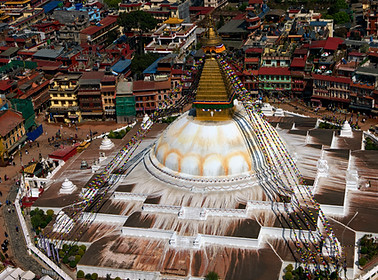
After the conference, we exchanged a few words, and he said to me, “Why don’t you come to Nepal?” We went to Nepal with a group of 22 friends brought together by Rémi Tremblay, who was leading a leadership organization. We fell in love with Boudhanath and decided to help fund the clinic. That’s how I encountered Karuna.

How did you move from that moment to becoming President? What motivated you to commit at that level within Karuna?
Over the years, I developed a deep friendship with Matthieu. We traveled together quite a bit. The decision by this group of Canadians to support the Shechen Clinic eventually led to the creation of a Canadian branch of Karuna, and I accepted its presidency—a role I still hold today.
Over time, I joined the International Board of Directors, and then I was asked to take on the presidency. I was very happy, because I believe this is a pivotal moment.
Seeing the work carried out in the field deeply affected me… I can describe it only as a genuine opening of the heart. Projects have evolved—some activities have ended, others have been launched, and new regions have been added. But this opening of the heart, born from witnessing and experiencing how teams work on the ground, remains profoundly present.
Is there a moment of “opening of the heart” from the field that you would like to share?
Oh, there are many.
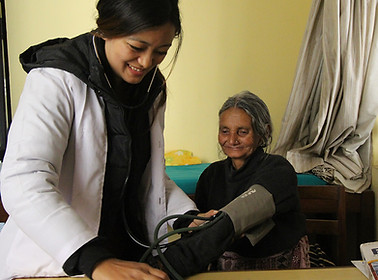
One of the most striking moments—probably because it was one of my first visits—was at the Shechen Clinic at a time when we were providing palliative care. Everyone knows how emotionally demanding palliative care can be. And yet, the serenity and human quality present in that clinic completely overwhelmed me.
And seeing the work carried out in the field truly marked me… I can speak of nothing other than a genuine opening of the heart.

How has your journey with Karuna—today as President, but also previously as a friend, volunteer, and donor—contributed to your spiritual journey? And perhaps the other way around as well?
It completely changed me—both ways. Above all, it is first a personal path that opens us up and guides us toward others. In my own journey, I observed how my involvement in humanitarian work strongly influenced my way of leading.
For example, when I became Deputy City Manager of Montreal, I suggested that kindness be included in the evaluation process for all 28,000 city employees. I thought they would tell me, “You’re crazy, Charles—that makes no sense!” But it went through effortlessly.
I’m certain that if I hadn’t had that first encounter with Matthieu, I probably would never have had that idea. And I saw how this journey profoundly changed me—showing how we often underestimate the impact such paths can have, not only on ourselves, but also on those around us.
You mentioned a pivotal moment earlier. Karuna is celebrating its 25th anniversary this year—a symbolic milestone. What do you see as the priorities and challenges for the next 25 years?
There are many challenges ahead—not only for the next 25 years, but even in the years to come.
For me, the main challenge in the humanitarian sector is listening closely to the needs expressed by the communities we support. And this is something we already do very well. We must continue to do so—and do it even better.
Another challenge lies in the quality of relationships within teams, in order to care for the physical and psychological well-being of both the people supported and those who support them.
Finally, there is the crucial challenge of financial sustainability: diversifying income sources and ensuring the continuity of our actions in the years ahead, despite the global trend of declining donor engagement. Yet I remain optimistic, because Karuna has such a distinctive mission and such a deeply human and inspiring way of operating. That is truly its strength.
For me, the main challenge in the humanitarian sector is listening closely to the needs expressed by the communities we support. And this is something we do very well. We must continue to do so—and do it ever better; it is essential.
Within this commitment you embody, there is a strong sense of self-giving. We wanted to talk with you about giving. In your view, what link exists between Karuna’s donors and the communities, even if they may never meet in person as you did?
I believe the bond that cements this relationship is testimony—and we must take great care of it. The testimonies of the people supported, as well as those of field teams. Everything that allows donors to encounter, in one way or another, the people involved: Matthieu’s writings, photo books, Karuna’s annual reports…
And what would you like to say to people who make “small donations” and wonder about the impact of their gesture?
I would say there are two answers. First, the butterfly effect: their donation contributes and can create a crucial multiplier effect.
But the second element—and the most important for me—is that giving is an act of generosity. The act of giving transforms the person who gives, and then, in turn, their surroundings. There is a moment when they are touched—even if it lasts only an instant, even if they later forget it—and it changes them from within. They carry that gesture within themselves. And this effect has nothing to do with the amount given.
Thank you.
Thanks to you.
.jpg)

_edited.jpg)
