

PORTRAIT 20
Raphaële Demandre
In the early days of Karuna
A close friend of Matthieu Ricard, Raphaële Demandre supported him before the official creation of Karuna Shechen in 2000 to build schools, clinics, and bridges in Tibet, India, and Nepal.
Having traveled to Tibet since 1986, she understood the immense needs of Tibetans living in precarious situations.
Twenty-five years later, she looks back on some anecdotes from the past in an interview with Marilou Mourgues. In daily contact with local teams, Marilou devotes her energy to implementing projects and strengthening ties between headquarters and the field. Together, they look back on a quarter-century of commitment, evolution, and impact in close collaboration with the communities they support.
In your memory, how did Karuna come about? Where did the idea for this organization come from?
Raphaële : At the very beginning, the Dalai Lama called on Tibetan monasteries that had developed in India and Nepal to consider caring not only for Tibetans in exile but also for the poor populations living around them. At the same time, Rabjam Rinpoche, abbot of Shechen Monastery (where Matthieu still lives) in Kathmandu, was also very inspired by Mother Teresa and had begun to develop a small dispensary in the monastery of Bodhgaya, in Bihar, India, for a destitute population. Matthieu, following the great success of the book he wrote with his father Jean François Revel, “The Monk and the Philosopher,” suddenly received a large sum of money, which he put toward Rabjam Rinpoche's wish to build a large clinic next to the Shechen monastery in Nepal. A group of friends wanted to finance more projects, and this eventually led to the formal creation of the Karuna Association, whose name means tenderness, kindness, and compassion in Sanskrit.
Matthieu and I spent most of the year in India, Nepal, and especially Tibet, and during our meetings, our friends shared their needs with us, which is how projects were developed and carried out. Every year, Matthieu wrote detailed and precise reports accompanied by our photos, and so the small circle of volunteer friends grew both in the field and in France, until eventually we had employees working in a larger organization, because year after year there were more and more requests for help, especially when we went to Tibet. We built around fifteen large dispensaries and clinics, paying salaries and medicines for years. On each trip, we took stock and did the accounts with the doctors. It was often a headache, but always very friendly and joyful.
In rural areas and among nomadic peoples, schools were often little more than ramshackle huts without toilets. Education was mainly reserved for boys. We strongly encouraged and paid for girls to attend school. Some became doctors and teachers. Over a period of twenty years, we created or financially supported around fifteen schools, and the last one in Shechen was built to “earthquake-proof” standards following the earthquake in Yushu. With the help of local friends and the mayor, over four years I was fortunate enough to build a school for 700 children, and in the end 1,200 enrolled, coming from around twenty villages. For more than ten years, it broke all records, with the best teachers, the best students, the best environment... It was the “pilot school” in the region, especially for Tibetan, and the curriculum lasted 12 years! We are still in touch with many of our students!
Matthieu and I spent most of the year in India, Nepal, and especially Tibet, and during our encounters, our friends shared their needs with us, which is how projects were developed and carried out.
Et toi, comment es-tu arrivée dans Karuna ?
Since childhood, I had been fascinated by the spiritual world. When I first came into contact with Tibetans in Hawaii at the age of 20, it felt very familiar to me. My life was a patchwork of aikido, tapestries, vegetable dyes, Egyptian hieroglyphics, but above all, a passion for saving whales and protecting the ocean. So I quickly got involved, joining the small group that started Greenpeace in France. I spent four years on boats, including the famous Rainbow Warrior. We often found ourselves in exciting but difficult and very dangerous situations!
For my thirtieth birthday, my mother suggested I accompany her on a short trip to India. I ended up staying for six months and met the great lamas who later became my teachers, including Dilgo Khyentse Rinpoche, whom Matthieu Ricard accompanied. When I met the Dalai Lama, I was completely dazzled by his intelligence and won over by his joyful charisma. There weren't many of us at the time during that first meeting in his home. When I asked him, “Which is more important, world peace or peace of mind?”, the Dalai Lama replied, "It is more important for you to follow Buddhist teachings for nine months of the year. You will be more successful in your actions. Then you will find balance." So that's what I did. I enrolled in Tibetan classes at INALCO, at Dauphine University, and spent almost the entire year with the lamas in Nepal and France. Matthieu often translated at that time, and we realized that we were cousins by marriage! (It was useful to be able to say we were cousins, because Matthieu was a monk, and therefore celibate, so it would have been awkward for him to be often accompanied by a woman who wasn't a member of his family. So it was convenient!). The teachings on altruistic love were essential; we were imbued with and kneaded by the kindness and wisdom of the Masters.
As you can see, I didn't just “arrive at Karuna”... I was there from its conception to its birth, and now I'm watching it grow!

.jpg)
And so, with the creation of Karuna in the early years, activities began to expand. What were you doing at that time? Were you in the field?
At first, no one was officially involved. We were just friends helping each other out here and there, at the clinic, at the monastery, during our travels. Matthieu was actually the conductor. Perhaps what was useful was my ability to connect the Tibetan, Nepalese, and Indian worlds with Westerners. It helped spread the word about our activities and maintain our networks. The activities multiplied and were amazing: clinics, bridges, the construction of schools such as the bamboo schools in Nepal, which for me was one of the most exciting projects because they could accommodate 1,000 to 2,000 children for just €1 per month! There too, I acted as a liaison between sponsors and teams. I did a lot of field research to ensure that the projects were as well designed as possible, learning a lot from the experience of other NGOs, their successes and their mistakes.
In Tibet, we had long visas at the time, for six months, and I was there as much as possible. There was no such thing as weekends or comfort, often spending hours on bad roads, but it was a joy to reconnect with friends who needed our help.
Despite everything, we were able to do a lot of good and be successful. I was so happy to be able to help as best I could with all of this.


Is there an example or anecdote from a project you worked on with Karuna that you would like to share, something that made an impression on you?
There was this program called “Save the Mother and Child.” Matthieu and I realized, while conducting surveys among nomads, that there were a lot of women dying in childbirth and children dying very soon after birth. We decided to bring in the organizers from the One Heart association to see how we could do something about it. One day, when I wasn't even there, they decided that I would be the project director. Without really understanding what I was getting myself into, I ended up in Lhasa for a three-month training course with Tibetan women, led by an amazing Vietnamese gynecologist. The course was designed for midwives, so that they could then pass on this knowledge to the villages and nomads, who were to continue the demonstrations “in cascade”.
We produced a booklet of drawings, inspired by the UNICEF booklet in Africa, with all the information translated into Tibetan, with translations also in Chinese and English. I know that these booklets are still in use today! Everyone was delighted, especially the nomads, who rarely have books in their hands, and especially on this subject, which is kept secret as if giving birth were dirty or shameful... In addition, as I wanted to use VHS cassettes, which were very popular at the time, since Tibetans all have TVs with cassette players, even in tents, we set up and filmed theatrical scenes with the midwives, who acted out situations to introduce basic hygiene, such as using new razor blades and not a more or less rusty meat knife to cut the umbilical cord, for example. Everything was filmed and performed in the three Tibetan dialects. The booklets and cassettes were a real success, and we printed and distributed thousands of them!
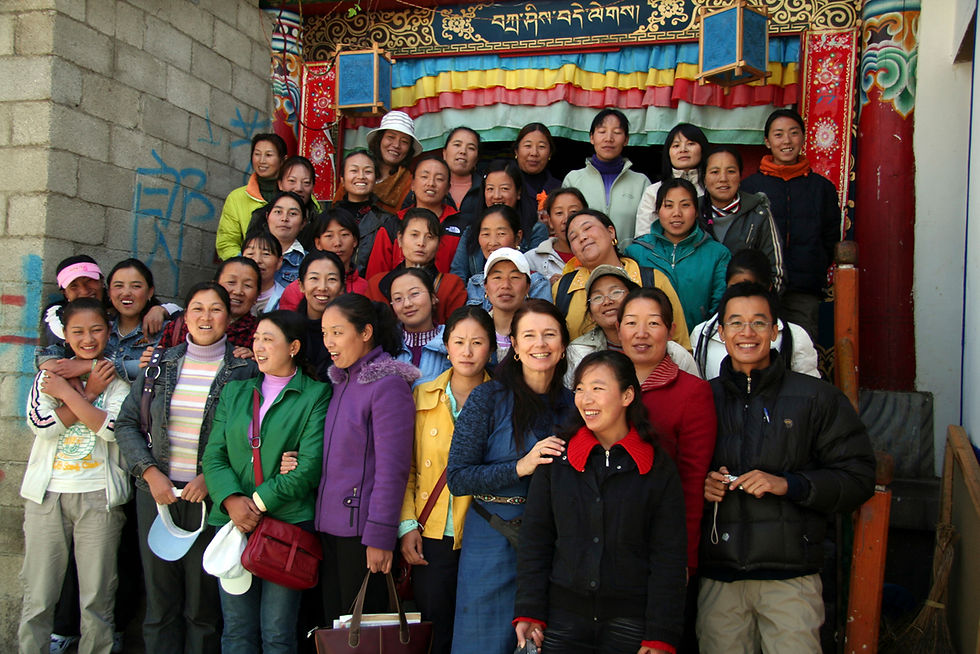
For several months over a six-year period, I worked tirelessly with a Tibetan friend. At markets, we would buy "a doll of a big, chubby baby that laughed whenever it was shaken, so whenever there was a bump in the road, children and nomads would rush over, delighted by this rare sight. We also bought all the equipment we needed for our demonstrations: hundreds of dolls, fabrics, balloons (the dolls' lungs), and tubes to demonstrate mouth-to-mouth resuscitation. The car was packed to the brim! Finally ready, we set off singing “I give you all the happiness in the world” towards the heights of Tibet, to communities or in the middle of fields to give a little demonstration, which the spectators had to repeat in front of us, “hands on”! This included how to hold the baby in a squatting position, dry it, keep its head warm, breastfeed it, and so on. I was sometimes accompanied by monks to translate. The subject was serious, but it was also a lot of fun! We distributed everything: CDs, booklets, razor blades, medicines, and dolls. When we had more organized events, we brought together doctors and midwives for presentations and gave them awareness kits so that they could teach the villagers, using a “cascade” approach. The techniques had to be spread as far as possible by word of mouth because people are often very isolated from each other, so everyone needs to know the right reflexes. I know that I systematically met with the health official in each prefecture, and we managed to organize weekends bringing together more than 100 midwives, up to 300, from villages throughout the region. I kept everyone's names and phone numbers, and yes, I still have that large network.
The techniques had to go as far as possible beyond word of mouth because people are often very isolated from one another, so everyone needs to know how to respond appropriately.


That must have been a difficult situation?
Yes, and what's more, it was difficult to estimate the benefits: how many children had we saved with all this? I heard reports, a doctor I ran into told me, “This happened, thank goodness you trained that man,” etc., I heard about it indirectly. Once, something unforgettable happened. My translator and I arrived in the village at nightfall, and someone came to get us, saying, “Come quickly, come quickly, someone is dying!” So, of course, we went, and there we found a very young woman lying on the ground under a large sheepskin garment in a small white tent in the courtyard near the house. She was in bad shape, having been in labor for perhaps more than 20 hours. Her mother was nearby, not knowing what to do, and the men were in the house but far away from all this! The girl moans in pain and cries. I call a good friend who is a gynecologist in a town about twenty kilometers away, and we decide to take her there immediately. It's nighttime, so I put the poor girl in my car, along with her husband (by force!), and off we go on the horribly bumpy road, the poor woman screaming in pain. I have to stop often. We arrive at the small clinic, the gynecologist takes care of her and immediately induces labor. The baby comes out... a little girl, but blue and dead! Immediately, as all three of us knew the technique, we start blowing one after the other, mouth to mouth on those little blue lips. And then, suddenly, a soft cry, and then she cries! Extraordinary! The mother takes her baby to her heart and smiles breathlessly, the father, who was smoking a cigarette outside, rushes in. That was the moment when I saw that our resuscitation techniques really worked. We were all so happy.
Mais voilà, d’habitude, comme je ne pouvais pas voir l’impact, je me disais juste : heureusement qu’on leur donne les bouquins, qu’on leur en parlé, qu’on a cassé le silence. Traditionnellement, dans ces régions-là, les femmes accouchent dans une petite tente blanche, sans eau chaude, accompagnée d’une femme de la famille qui ne s’y connait pas très bien, souvent en haut de la colline, parce qu’on ne veut pas que le sang salisse la maison alors ça se passe souvent entre les vaches, à l’endroit où tout le monde fait pipi, où il a vraiment beaucoup de microbes. En fait, grâce à ce programme je crois que nous avons ouvert la discussion et les échanges dans les familles au sujet de la naissance, ce sujet tabou et pourtant si essentiel !
That's a very impressive example, thank you!
I wonder: what do you think has remained unchanged in Karuna's spirit since its creation 25 years ago? What do you think keeps it the same organization, with the same DNA?
You know, Karuna is a very well-known word in Sanskrit. In France, there are words that are commonly accepted, such as “karma” or “mandala,” but karuna has the same status. I know girls named Karuna. And in fact, the concept of Karuna is the concept of love. It is a force that runs through our entire lives, from the moment we are born until the moment we die. When you think about it, we live with karuna, present in the love of our mother, our family and friends; it surrounds us all the time. What I mean is that this line, this intention to help others, is at the heart of all NGOs, and so for me, what was in Karuna and what is still there, this DNA, is that: it's love, the desire to help. That's what drives us. And then there is the even more spiritual meaning linked to Buddhist teachings of seeing this Karuna love as a dream! Matthieu can tell you more about that!!!!
What I mean is that this approach, this desire to help others, is at the heart of all NGOs, and so for me, what Karuna had and still has, its DNA, is love and the desire to help. That is what drives us.
Thank you, Raphaële, for telling us all these stories about Karuna's beginnings!
Thank you and all the best!
.jpg)

_edited.jpg)
