

PORTRAIT 22
Pinki Kumari
Supporting Women in Her Community
For more than a decade, Karuna-Shechen has worked to promote women and children’s health across rural Bihar and Jharkhand, recognising that socio-economic development begins with female empowerment. At the heart of this effort, at Karuna-Shechen India, are the Community Health Mobilizers who translate information into action at the grassroots level. Among them is Pinki Kumari in Bodhgaya, whose work exemplifies how sustained presence, trust-building, and scientifically grounded awareness can transform attitudes toward menstrual health and hygiene in underserved communities.
Below is an excerpt from a conversation with Pinki, where she speaks about her journey, the challenges women face, and the quiet but profound impact of awareness work.
Could you introduce yourself and tell us a little about your family?
Pinki: My name is Pinki Kumari. I am 28 years old and live in Ilra, Bodhgaya. In my family, I have my mother-in-law, my son, and two daughters.
Before joining Karuna-Shechen, what were you doing, and how did you first learn about the organisation?
Pinki: I used to teach in a non-profit school. I first learned about Karuna-Shechen through the Anganwadi Centre where I was introduced to the ECD curriculum and learning while dropping my four-year-old son. I used to see the activities conducted there, especially those for emotional and social development of children and I was very inspired by them. It made me want to contribute to this kind of work within my own community.
When did you join as a CHM, and what does your role include?
Pinki: I started working as a Community Health Mobilizer on 19 March 2019. My work involves holistic child development through the Early Childhood Development curriculum at Anganwadi Centres. Along with that, I support activities like seed distribution, hygiene and nutrition awareness, and outreach to pregnant and lactating mothers.
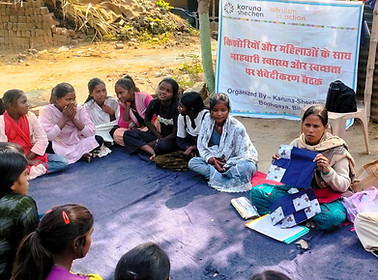
In WCH, I mainly work with adolescent girls and women to improve their health-seeking behaviour. The focus is on creating awareness, discussing challenges and pain points, and addressing taboos. At Karuna Shechen, we strongly promote sustainable menstrual practices, and I have been actively raising awareness and distributing cloth pads and sanitary napkins in the community.

What does your day-to-day routine look like?
Pinki: We prepare a monthly plan in advance, so every day begins with clarity. I know where I need to go and which activity I need to lead. With support from the sevikas and sahayikas, I mobilise the community and conduct awareness sessions with women and girls.
From your experience, what challenges do girls and women face regarding menstruation?
Pinki: When we began, there was very limited awareness. Girls and women hesitated to talk openly about menstruation. Many were using old cloth pieces that were not hygienic or safe.
Over time, we have seen a big improvement. Now they participate in meetings, ask questions, and share what they learn with others. When they switch to cloth pads and maintain them properly, they notice positive changes, fewer infections, more comfort, and a sense of dignity.
Another challenge is that sanitary napkins are not always available in local shops, and many do not know how to dispose of them safely. Cloth pads have become a practical and affordable solution. During field visits, I also go door to door to ensure women have access to them.
Now they participate in meetings, ask questions, and share what they learn with others.


Why do you feel it is important to talk openly about menstruation?
Pinki: Menstruation is completely natural; it is essential for the continuation of generations. It is as normal as the blossoming of trees. If we don’t talk about it, girls and women may never share what they are going through, and that silence can lead to serious health issues.
How do you build trust with girls, women, and their families?
Pinki: We begin by surveying and identifying girls and women in the 10-20 age group. We first speak with families, most are already familiar with Karuna-Shechen and explain how WCH activities and awareness can benefit the women in their household.
When I meet the girls in the community, I share my own experiences and struggles with menstruation. This helps them trust me and open up about their questions.
Have you faced resistance in your work?
Pinki: Yes, sometimes the resistance comes from within the group. Even after explaining the benefits of cloth pads, some girls or women remain strongly attached to old habits and do not want to consider alternatives. Some hesitate even to listen at first. But with patience and repeated engagement, many eventually become more open.
Your personal journey since 2019 has involved significant challenges. How has this work shaped you?
Pinki: When I started this job, my father-in-law supported our family. After he passed away, and later, when I lost my husband, I suddenly had to take care of my three children on my own.
I have gone through a lot emotionally, but I never allowed my personal difficulties to affect my work. Helping even one person meaningfully gives me strength. This work taught me the importance of standing on my own feet. Even when people questioned me for being a single working mother, I continued because I believe deeply in the honesty and purpose behind what we do.
What hopes do you have for the girls and women you work with?
Pinki: I want them to understand the importance of learning. If I were not educated, I would not have been able to support my family or educate my children. I hope they continue breaking menstrual taboos, share their knowledge with others, and face challenges with confidence.
Most of all, I hope no girl ever misses school because of menstruation, and no young girl feels scared or alone during her first cycle.
Today, in the villages where Pinki works, adolescent groups meet more regularly, girls ask questions without hesitation, families are more open to discussion, and school attendance during menstruation has improved. The change is steady,built through patience, trust, and the daily presence of women like Pinki.
Her journey embodies the spirit of Karuna-Shechen’s Women and Child Health programme: transforming lives through compassion, knowledge, and the quiet insistence that every woman deserves dignity and a voice.
.jpg)

_edited.jpg)
